


Page 94 - Work8_2014_Parsons
P. 94
A Star(burst) is Born.

In the aftermath of World War II, Southern California
reaped the benefits of wartime innovation, with technolog-
ical advancements ushering in a new period of economic
prosperity and a corresponding population boom. Southern
California was using its newfound wealth to focus on the
American Dream: marriage, family, single-family homes,
personal automobiles, and free time for recreation.8 These
factors, coupled with the warm Southern California cli-
mate, created the perfect backdrop for the rise of Googie.

Interiors were a reflection of these aspirations. Southern
Californians wanted large lawns, indoor-outdoor living
areas with patios for entertaining, kitchens equipped with
modern appliances, walls of glass to unify the indoors
and outdoors, and open floor plans featuring connected
kitchens, living rooms and dining rooms for ease of daily
life and entertaining.9 Commercial spaces were not much
of a departure from their ideal domestic spaces. This was
demonstrated through the prevalence of Googie-style
restaurants in the 1940s and 1950s, with common attributes
including large plate glass windows, indoor-outdoor
spaces, exhibition kitchens equipped with modern appli-
ances, and open floor plans that provided unobstructed views
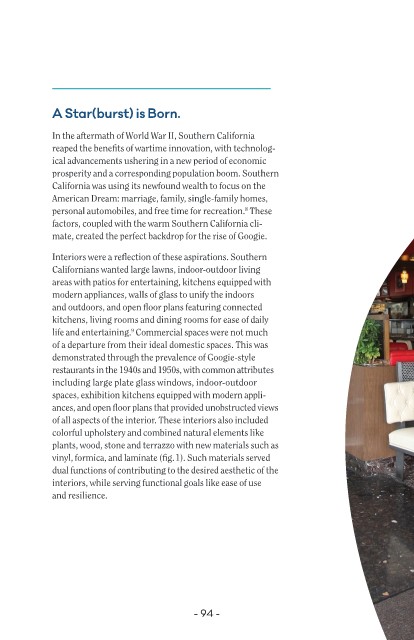
of all aspects of the interior. These interiors also included
colorful upholstery and combined natural elements like
plants, wood, stone and terrazzo with new materials such as
vinyl, formica, and laminate (fig.1). Such materials served
dual functions of contributing to the desired aesthetic of the
interiors, while serving functional goals like ease of use
and resilience.

                                             - 94 -

