


Page 93 - Work8_2014_Parsons
P. 93
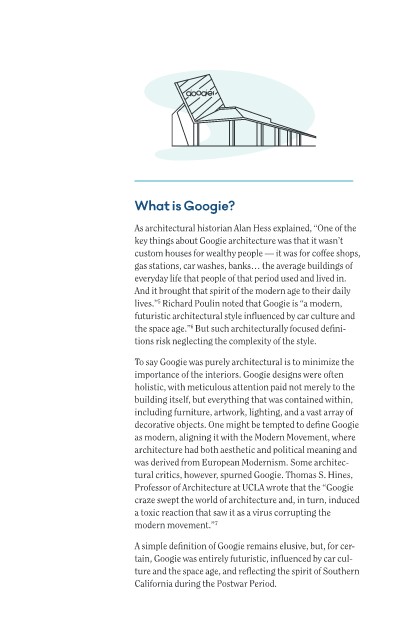
What is Googie?

As architectural historian Alan Hess explained, “One of the
key things about Googie architecture was that it wasn’t
custom houses for wealthy people — it was for coffee shops,
gas stations, car washes, banks… the average buildings of
everyday life that people of that period used and lived in.
And it brought that spirit of the modern age to their daily
lives.”5 Richard Poulin noted that Googie is “a modern,
futuristic architectural style influenced by car culture and
the space age.”6 But such architecturally focused defini-
tions risk neglecting the complexity of the style.

To say Googie was purely architectural is to minimize the
importance of the interiors. Googie designs were often
holistic, with meticulous attention paid not merely to the
building itself, but everything that was contained within,
including furniture, artwork, lighting, and a vast array of
decorative objects. One might be tempted to define Googie
as modern, aligning it with the Modern Movement, where
architecture had both aesthetic and political meaning and
was derived from European Modernism. Some architec-
tural critics, however, spurned Googie. Thomas S. Hines,
Professor of Architecture at UCLA wrote that the “Googie
craze swept the world of architecture and, in turn, induced
a toxic reaction that saw it as a virus corrupting the
modern movement.”7

A simple definition of Googie remains elusive, but, for cer-
tain, Googie was entirely futuristic, influenced by car cul-
ture and the space age, and reflecting the spirit of Southern
California during the Postwar Period.

